- Authors

- Name
- Ville
- @ville
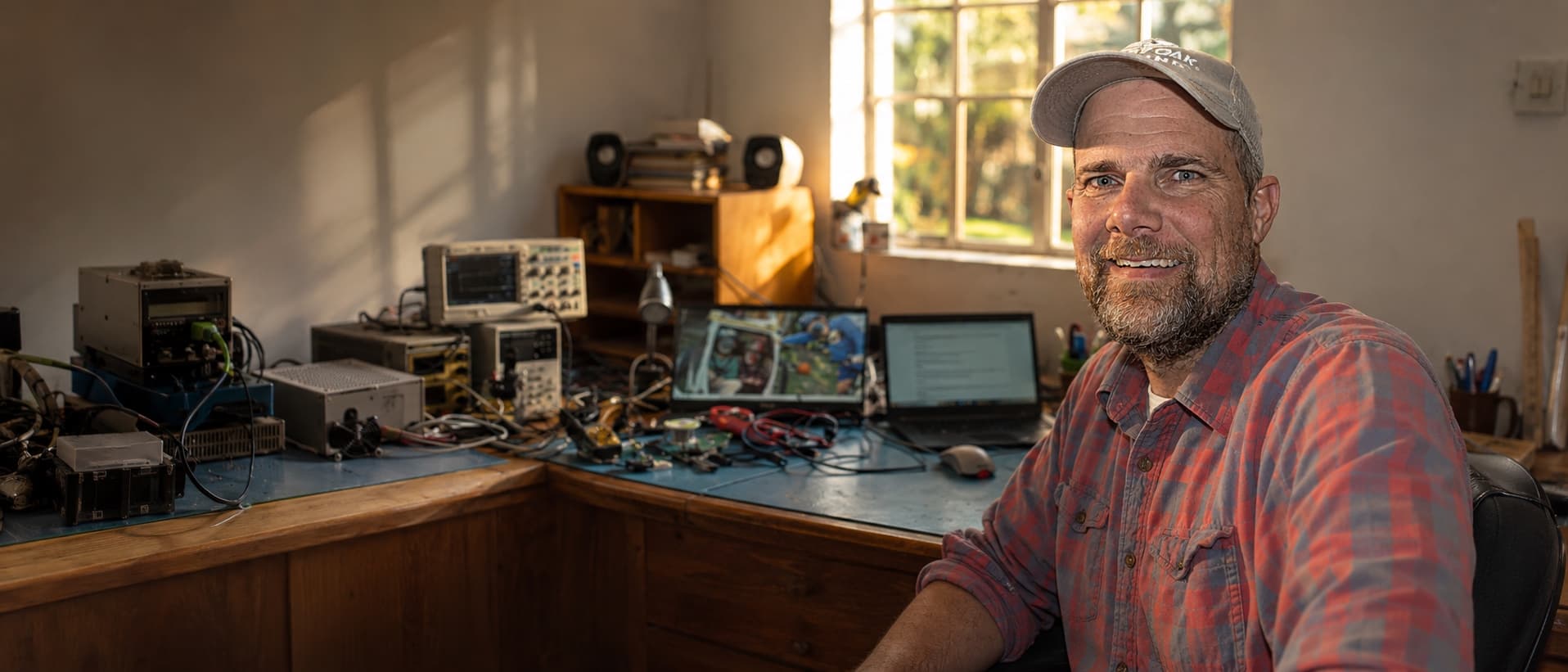
Somewhere far away from the Kenyan main roads, where the sounds of birds and the occasional dog drown the traffic noise, Kurt sits at an L-shaped desk in a small detached garage. He's trying to read a Bitcoin mining chip nobody outside its Chinese factory has ever publicly described.
One of the promises of Bitcoin is that it's transparent and open. The code is open-source, so you never have to take anyone's word for it. This is what the Bitcoin community means when they say "don't trust, verify." You can read the code, run a node, and confirm the rules for yourself. But the hardware that performs the computational work that keeps the system running remains mostly closed. Bitcoin miners arrive as sealed boxes from a few giant companies, most of them based in China, whose designs are proprietary and whose chips are inscrutable.
Kurt has been thinking about this problem from his garage in Nairobi, where he has been working on something small, stubborn, and strange: an open-source Bitcoin miner called Bitshoka Nini.
Its design files are open, and the board can be studied, copied, changed, and fabricated again. While the project is a clear underdog, it might yet change the status quo, or at least that's the hope. The struggle it represents isn't about beating industrial miners at their own scale. Rather, it's about knowledge, access, and who gets to understand the machines that keep Bitcoin running.
The Bitshoka project aimed to reverse engineer MicroBT's WhatsMiner chips and make them open-source, enabling solo mining and increasing decentralization in Africa.
On one side of his desk sits a Weller soldering iron, and an old power supply from the 1970s—fished from the trash in the early 2000s, repaired more times than he can count, and still working, albeit begrudgingly. "To me, it represents the values of recycling, recovery, and quality," he says. "It's a reminder that old is often just as good as new! I doubt my newer digital supply will be working 50 years from now." Even the workbench has family history: it's the old dining table Kurt's wife remembers making cookies on as a kid at her friend's house in the '80s.
Anything I leave on the desk quickly gets a nice layer of African dust on it!
On the other side, Kurt has an old Lenovo T460s with a red TrackPoint (to which he is admittedly addicted). The laptop runs Linux, hosts a local LLM, and interfaces with his electronics.
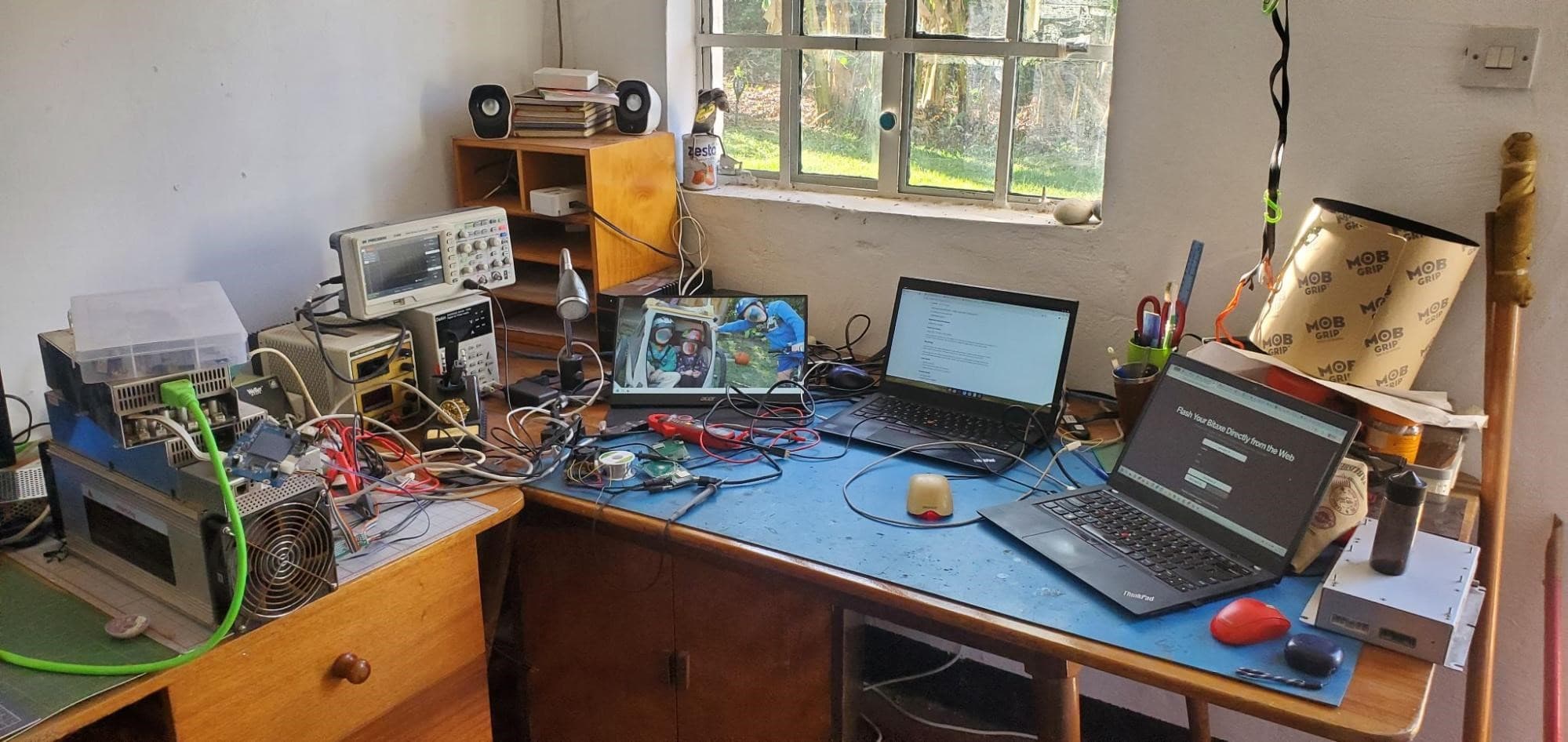
In his garage, he keeps a floor-to-ceiling homemade shelf filled with totes of plumbing and electrical parts. "In Kenya, houses always need fixing!" he says. He adds that "an old dresser holds spare bike parts and another dresser holds various electronic spare parts and things that I've been meaning to fix but probably never will."
I actually really like my home lab—though my wife cannot understand how I get anything done in there!
Kurt is known online as kuenrg153. The name comes from his high school days. In physics, k stands for kinetic energy in a system, and u for potential energy. Together, they're the total energy. The "enrg" at the end just sounds like "energy," depending on how you read it. Erg, as it happens, is also a unit of energy.
That's the kind of thing only an engineer full of energy would come up with. The funny part is that after all these years, Kurt still doesn't really know how to pronounce his nom de guerre. Neither do I.
Kurt calls himself a "fairly experienced hardware and electrical engineer who also happens to be a bit of a Luddite in some ways—yes, a walking contradiction!" While mostly a jest, he does recognize that "every technology adoption brings compromises that we may or may not be aware of." After all, he's been "developing hardware electronics, some of it very cutting edge, for over twenty years."
Kurt doesn't seem like someone who found Bitcoin through memes, price charts, or because a suited evangelist in an orange tie converted him. Neither hyperinflation nor censorship forced him to look for alternatives. He came across Bitcoin through electric power and wires, broken machines, and the question of what practical infrastructure could look like in places where it's not taken for granted.
Long before any of that, though, like all engineers' hero stories, there were LEGO bricks. Technic, specifically.
I'm one of those people who has always known, without any doubt, that I would pursue engineering / tech as a career. Every Christmas and birthday, the question wasn't, "What will my presents be?"—the only question was, "Which Lego set will I get?!?!"
One of his earliest electronics memories is from seventh or eighth grade, trying to make a Morse code machine out of a cheap soldering iron, solder, and cereal-box cardboard. He doesn't remember finishing it, but he remembers burning his arm on the iron. He also built a generator out of Lego Technic, which may or may not have worked, too.
Much later, Kurt moved with his wife to rural Tanzania. There they lived for three years without relying on much of the public infrastructure that people in wealthier countries treat as normal. That's where he realized how open-source empowers people.
Most people there couldn't afford proprietary software, so they relied on pirated copies of Windows, Office, games, even antivirus programs. Nearly all of it came loaded with viruses, and Kurt ended up spending much of his time cleaning infected computers and flash drives. Open-source was the only software he could count on to be both free and safe. He preached Linux and OpenOffice every chance he got, but in a place where people were still learning the basics by teaching each other what they knew from others, asking them to switch tools was tough.
During those years in Tanzania, the family grew by two (and later by three), and Kurt's interest in renewable energy grew with it. He moved back to Canada to study electrical engineering, then returned to Kenya to work on hardware for emerging markets.
Eventually, that path led him to Gridless, the Nairobi-based company that uses surplus renewable energy in rural Africa to mine bitcoin. There, Kurt applied his knowledge and skills to maintain and repair the mining hardware. That's where Bitcoin became less magic internet money and more infrastructural fact.
My own, smaller, a-ha moment came when I realized how truly open-source it [Bitcoin] was.
The bigger picture clicked when he started thinking about microgrids. Small hydro and solar projects across rural Africa share a common problem: the communities around them need power, but not steadily enough to keep the project viable. Surplus electricity goes unused.
That's when Bitcoin miners can take whatever power the village isn't using, and then go quiet when the village needs the electricity. In doing so, the community gets reliable electricity that it wouldn't otherwise have. Kurt remembers fondly that "it is quite a good feeling to see a small community productively using energy, knowing that it was partially enabled by the work I did to provide the baseload income which helped fund the microgrid."
And this is where open hardware starts to matter: if the miners are expensive to import, hard to repair, and built by a handful of companies far away, then the energy may be local, but the power still isn't.
Bitshoka Nini starts where most open-source projects do: building upon existing work. "Shoka" in Swahili means axe, hence the Bitaxe, an open-source Bitcoin miner that was also funded by OpenSats. In open source, copying is the point: someone publishes the files, then somebody else picks them up, builds, breaks, and fixes them before putting the work back into the wild.
The main difference between the two is the ASIC, or the application-specific integrated circuit. An ASIC is a specialist in a world of generalists: useless at nearly everything, but frighteningly good at one thing. Namely, guessing numbers until you get the right one. However, no one had publicly analyzed the chip codenamed KF1950, so Kurt had to reverse-engineer it from scratch. Kurt chose this chip, made by MicroBT for their WhatsMiner machines, because they are sold for "virtually pennies", as Kurt puts it. The other more common chip, Bitmain's BM1370, used by other open-source miners, costs about fifty dollars or so.
But truly, the proudest moments were when I confirmed that the first Bitshoka hardware could communicate with the ASIC and later when I interfaced with a WhatsMiner hashboard via the bitLode USB adapter board. Those initial "Hello ASIC" moments were amazing!
Opening up a chip like this will not make one tiny machine rival an industrial mine, and it doesn't have to. What it can do is let more people understand, build, repair, and take part in the hardware side of the Bitcoin community.
Kurt is part of OSMU, the Open Source Miners United, a community that understands its tiny machines won't beat the industrial farms on raw computing power. In the OSMU Discord, when asked about the value of home mining, one member answered immediately: "Vires in Numeris," a Latin phrase meaning "Strength in Numbers." The saying originates all the way back to 2011 in the BitcoinTalk internet forum, when people still experimented with the money.
The argument is not that one home miner can outmuscle an industrial operation. It is that many small miners, spread across many places, make the system harder to pressure through a few large targets.
And then Nini failed.
It wasn't the Nairobi dust, but rather the board could talk to the chip, but it couldn't mine. Kurt traced the issue to the power circuit and redesigned the board. He ordered a new version, but it hasn't arrived yet.
Despite the setback, Kurt says that he is able to keep going "because of support from my wife (and kids) as well as the great community [he has] in Nairobi—both in the Bitcoin space and out of it." He continues, "seeing the work that others around me are doing, and how my work can support them and vice versa, is also very encouraging."
Hardware development is hard; hardware development in Africa is even harder for a myriad of reasons.
For anyone who wants to help, Kurt points to the OSMU Discord. People can also message him there directly as @kuenrg. He's happy to help people contributing to open-source Bitcoin hardware. He's also apparently eager to give monologues on open-source peer-to-peer energy.
Right now, Kurt is guiding the development of Jua Kali—"hot sun" in Swahili—Bitcoin miners at Gridless. He's also working on something he calls Stimatofali—"stima" for electricity, "matofali" for bricks—an open-source way for solar home systems to share power with each other, like snapping electric bricks together.
Receiving the grant is what allowed Kurt to work on reverse engineering the hardware full time. He says that without OpenSats, he wouldn't have had the time or justification to spend months studying the boards, translating the knowledge into a schematic, and then creating the circuit board.
OpenSats has provided incredible support. [...] The support from OpenSats helped me during every challenge along the way; without them, I would have felt that I should probably be doing my time and energy elsewhere.
So, for now, Kurt waits. He ordered ten new boards that are being made in the Nairobi fab, according to instructions he created. Until then, his logic analyzer and soldering iron stays out, ready.
Sometimes, against the odds, one of those small open-source miners scattered across the world finds a block—not bad for underdogs working from home. "When I look up from my work and the mess in front of me," he says, "I see a small lawn and a bunch of banana trees. There are often a bunch of bananas on the trees, which we try to harvest before the monkeys get them." Kurt, who hacked a computer chip and kept a fifty-year-old power supply alive, likes his odds.